In simple terms, a supernova is a stellar explosion. They are extremely radiant and can cause a burst of radiation which can briefly outshine an entire galaxy, before fading away from view over several weeks or months. During this period, the energy radiated by supernovae can be as much as the energy emitted by the sun. This explosion leads to driving a shock wave into the surrounding interstellar medium. This shock wave sweeps up a cloud of gas and dust called a supernova remnant.
Different kinds of supernovae can be triggered in one of the two following ways: either turning off or suddenly turning on the production of energy through nuclear fusion. If an aging giant star fails to generate energy from the nuclear fusion, it may undergo sudden gravitational collapse into a neutron star or a black hole, releasing gravitational potential energy that heats and expels the star’s outer layers. White dwarfs are subject to a different, much smaller type of thermonuclear explosion fuelled by hydrogen on their surfaces called a nova.
Those solitary stars with a mass below approximately nine solar masses, such as the sun itself, advance into white dwarfs without becoming supernovae ever. Supernovae can occur about once every 50 years in a galaxy the size of the Milky Way on an average. They enrich the interstellar medium with higher mass elements. The expanding shock waves can also trigger the formation of new stars.
Invention:
Since supernovae are somewhat rare events within a galaxy, regular monitorings of many galaxies are required to obtain a good sample of supernovae for analysis. But, supernovae in other galaxies cannot be predicted with any significant accuracy. So, when they are discovered, they are already in progress normally. Studying the peak luminosity and observing them is a pre requisite for studying and analyzing supernovae. Many astronomers have made significant contribution by discovering supernovae. They did this typically by looking at some of the closer galaxies through an optical telescope and comparing them to earlier pictures.
But, with the advent of computers, astronomers have started using computer-controlled telescopes and CCD’s for hunting supernovae. These modern technologies with the computers have proved to be a helping hand to the astronomers analyzing supernovae.
Types:
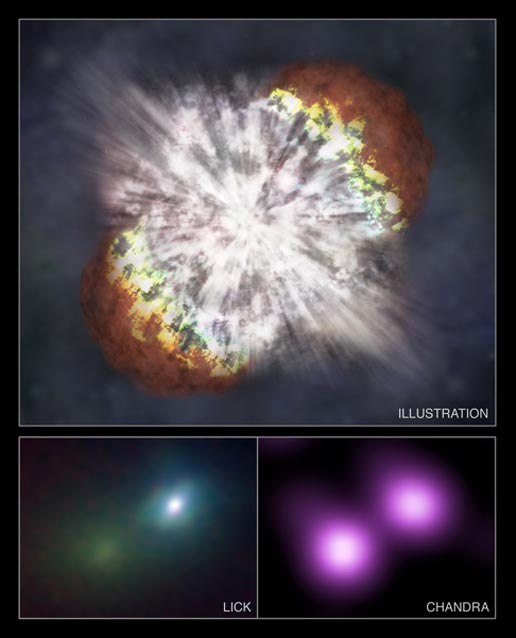
Brightest supernova taken by chandra telescope
Type 1a – lacks hydrogen
Type 1b – Non-ionized helium
Type 1c – Weak or no helium
Type IIP – Reaches a plateau in its light curve
Type IIL – displays a “linear” decrease in its light curve
A near-Earth supernova explosion resulting from the death of a star that occurs close enough to the earth to have clear effects on its biosphere.